Arpège Lanvin
Arpège by Lanvin is a Floral Aldehyde fragrance for women. Arpège was launched in 1927. Arpège was created by Paul Vacher and Andre Fraysse. Top notes are Aldehydes, Lily-of-the-Valley, Peach, Honeysuckle, Neroli and Bergamot; middle notes are Jasmine, Ylang-Ylang, Lily-of-the-Valley, Iris, Coriander, Rose, Lily, Geranium and Camellia; base notes are Sandalwood, Amber, Vetiver, Musk, Benzoin, Vanilla and Patchouli.
Arpège EDP available at a price – 7 EUR/ml.
This perfume is a winner of the 2005 FiFi Award Hall Of Fame.
Arpège (pronounced [aʁpɛʒ]) is a 1927 perfume created by perfumers André Freys and Paul Vache for Jeanne Lanvin and given to her musician daughter Marie-Blanche for her 30th birthday. Its name comes from the musical term “arpeggio”. Arpège is considered one of the world’s classic perfumes.
The fragrance is called the “fragrance of 1000 flowers” and contains about 60 floral essences. Like Chanel No. 5, released six years earlier, it is considered an aldehyde floral perfume.
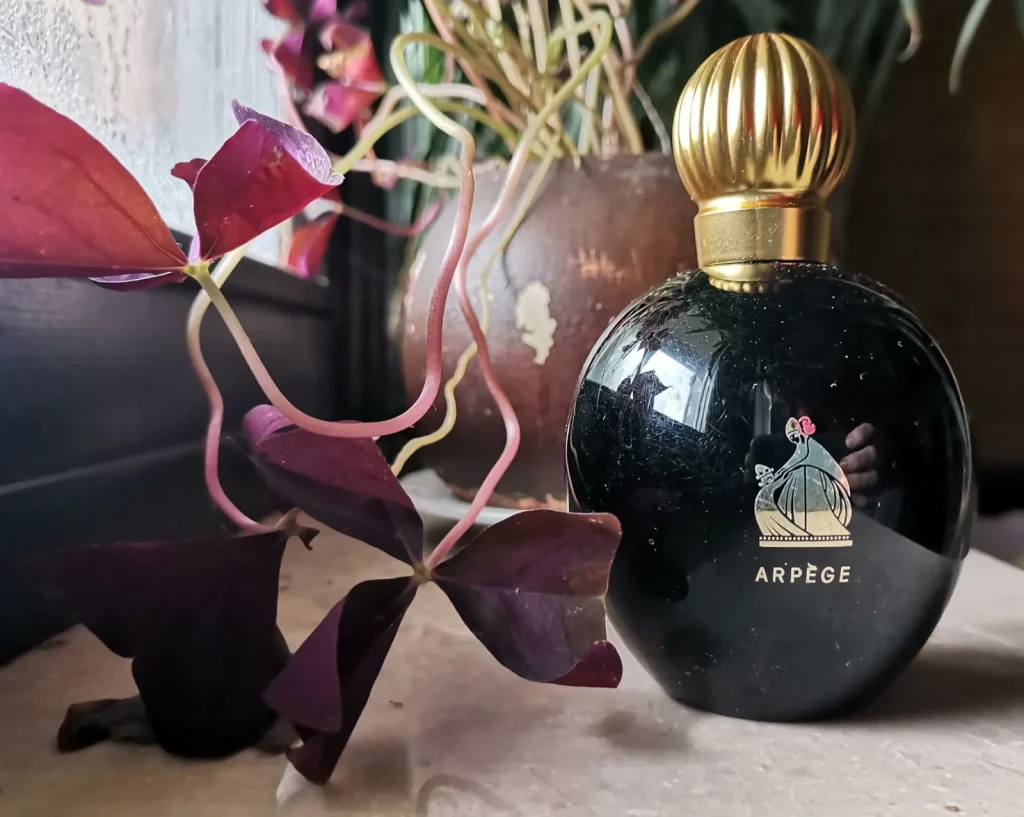
The original black bottle with a gold cap was decorated with a gold illustration of Jeanne Lanvin and her daughter, created by French fashion illustrator Iribe.
In 1993, the perfume was reformulated by Hubert Freys, André’s brother and founder of the perfume manufacturer Synarome. This perfume is a winner of the 2005 FiFi Award Hall Of Fame.
The house of Lanvin was once a benchmark of French fashion design glory, with a whole range of perfumes to match. From its first big hit My Sin (also known as Mon Peche) to the provocatively named Rumeur and Scandal and the illustrious Crescendo, Lanvin’s fragrances had both the prestige of the house’s fashion reputation and their own remarkable qualities to their advantage. Foremost among these was Arpège, created by Paul Vache and André Freys and launched in 1927, one of the most famous names in all of perfumery. It enjoyed great popularity for decades in the hearts and boudoirs of women around the world. It was named after Jeanne Lanvin’s daughter, Marguerite, as a pianist, as the name means arpeggio, a rapid playing of notes on a keyboard. Unfortunately, since founder Jeanne Lanvin’s death in 1946, the house of Lanvin has passed through several different owners, and is now owned by those who have allowed all the interesting perfumes of the past to fade away, leaving only a reformulated Arpège (by Hubert Freyss in 1993) and a revived Rumeur, which bears no resemblance to its original namesake. (A few recent releases bear Jeanne Lanvin’s name and, from the descriptions I’ve read, seem very out of character for the brand, although I haven’t tried them.)
I recently compared two copies of this fragrance from different eras, both in good condition. The older version was released in the sturdy square bottle that was once typical of the entire Lanvin line. The other is a transparent spherical bottle with a rounded plastic gold cap and the Lanvin mother-daughter logo on the side, a simplified design based on the classic black and gold spherical Arpège bottle. I don’t know exactly how fresh the latest bottle is, but there are definitely significant differences between what’s inside each of them, and the newer one is definitely a reformulation. What struck me about the older vintage (Extrait) was how complex and fast-paced it was, which is why its name is truly apt, and the contrast of its sharp herbal-bitter top notes with the deep and almost disturbing animalic base notes. Its carnal affinity with its naughty older sister, My Sin, is obvious, but it also has a rather stern sophistication, an almost intimidating aspect that I found captivating. (My nose had a hard time telling which style of perfume it belonged to.) It is actually a floral aldehyde, second only to Chanel No. 5, and one that has firmly established itself among the truly great perfumes of all time. Its use reveals layers of the scent over time; it is impossible to appreciate it in the first few minutes or even an hour. Bergamot, aldehydes, neroli, cloves and coriander create a sharp first impression, followed by lush, “dirty” florals that include Grasse jasmine and Bulgarian rose. The base is filled with musk, and plenty of it, as well as high-quality sandalwood and strong vetiver. It is the very definition of “femininity,” but not in the seductive “sexy kitten” sense of so many other perfumes. The woman who chooses this scent is deeply feminine, but also powerful, and she will not tolerate any nonsense from anyone. This was probably one of the most outstanding perfumes of its time, worn like a suit of armor; and this from a floral, not a leathery chypre outlaw! I first smelled this scent many years ago and had almost forgotten how distinctive it was. At the time I didn’t think it was for me, but now that I’m older and have a more educated sense of smell, I understand why it was such a success.
In another small bottle is the Eau de Parfum, it’s very concentrated, actually very similar to the Extrait de Parfum, but it’s a softer scent, without that herbal touch at the beginning, and it has sweeter floral notes. Indeed, the floral notes in the new Arpège include notes like mimosa and violet, and I thought I also smelled a faint hint of vanilla in the base. I found that last one hard to believe, so I looked it up, and yes, it’s true, there is vanilla here, which the original definitely didn’t have. It’s a pretty scent, and it’s very wearable, but even so, it lacks the intrigue of the older perfumes. I’ve seen it in discount online stores and wondered how different it was from the first formulation. If the re-formulation was intended to create a prettier scent, it worked, but the irony is that the original Arpège was actually more modern in its own way, a scent for strong and sophisticated women. The reformulated scent also has a distinctly powdery note that the vintage version lacks, and is somewhat more reminiscent of the original’s contemporaries, such as Sortilège by Le Galion and Chanel No. 5 than the first Arpège, although it lacks the warm, golden glow of either of those masterpieces. In that sense, it feels more “retro” than perhaps it was intended to be. Both are very long-lasting and would make great base scents for a grown-up perfume wardrobe. The real difference is that the original Arpège makes me think, puzzles me, and confuses me, and I keep coming back to it to figure out what it’s doing, while the new edition is beautiful in a more uncomplicated way. There’s certainly a place for both types of perfume, but I can’t help but feel a sense of loss. The first Arpège has remained a beloved icon for over sixty years, and I can’t help but wonder why the decision was made to give it a facelift, especially in the direction of making it “lighter” than it was before. Chanel didn’t want to remake No. 5 to make it more appealing to the masses, so why do it with an equally revered perfume story? Of course, this isn’t the first time a great perfume has been changed by new owners, and it’s not as disastrous as it could have been, so there’s something to be grateful for. Still, I’ll take the disturbing and mysterious beauty of the old over the smooth and somewhat hazy beauty of the new.