Niki de Saint Phalle Niki de Saint Phalle
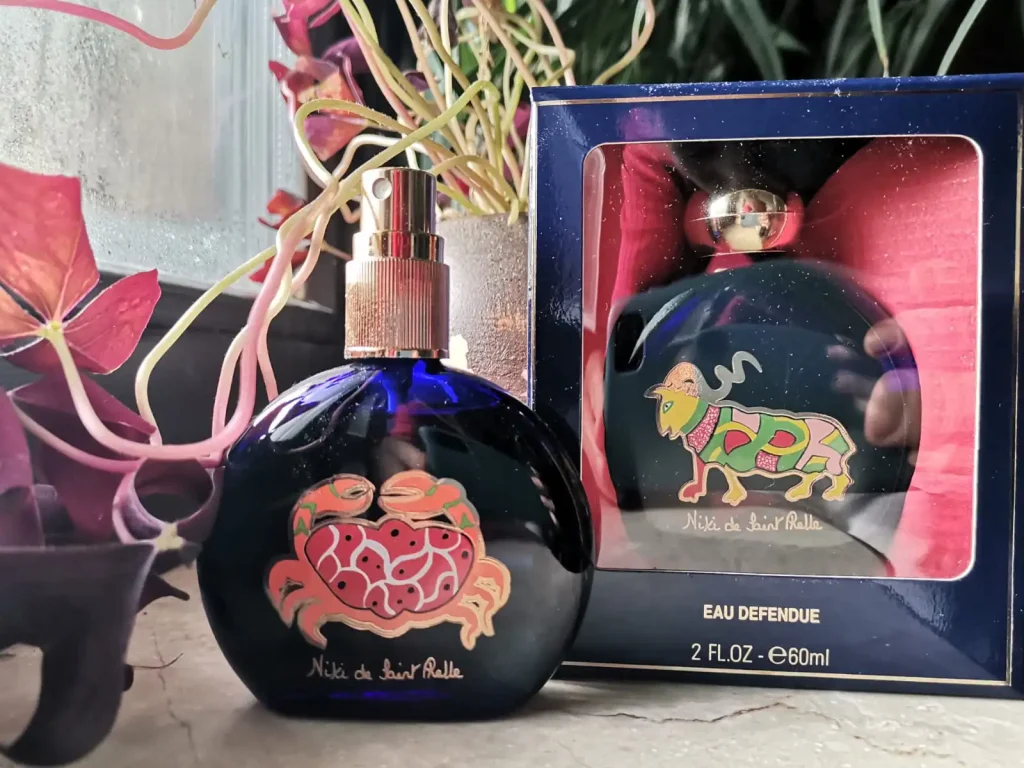
Niki de Saint Phalle by Niki de Saint Phalle is a Chypre Floral fragrance for women. Niki de Saint Phalle was launched in 1982. Top notes are Artemisia, Green Notes, Mint, Bergamot and Peach; middle notes are Carnation, Patchouli, Orris Root, Cedar, Rose, Ylang-Ylang and Jasmine; base notes are Oakmoss, Leather, Sandalwood, Musk and Amber.
Niki de Saint Phalle, the 1982 perfume by the late French-born, New York-educated artist, has just that kind of personality. It’s as far removed from the typical 80s creations as you can get, but it’s still bright, full of life and surprises. The most prominent note is the one that feels the most on my skin: marigold. I love these little symbols of summer sunshine and grow them in my yard every year. I plant them among my vegetables and herbs because they’re a natural insect repellent (if they were as effective on Steve the Groundhog and Sheldon the Rabbit, I might even have broccoli again). The flowers and leaves have a strong, pungent scent that I adore and could just bathe in. I know some people find this scent too strange to wear. The marigold has this combination of green and tobacco, and it’s quite different from feminine florals. But I think the other floral notes here, while soft and almost featureless, manage to keep the weirdness to a wearable minimum. The marigold notes are a bit muted in the musky-mossy sweet train, but they’re still there and maintain a green feel. I can’t say I can clearly smell any of the other stated notes (jasmine, rose, marigold, ylang-ylang, vetiver, sandalwood, patchouli, ambergris, musk), except for maybe the amber. I’m actually glad for that. The perfume is so well blended that it has a very distinct character that is completely true to the final product. There’s a tension between the tart greens and the spring flowers that works. It may have come out in the early 80s, but it really belongs to the 70s – the era of green chypre. This genre seems to be a thing of the past, although if the aquatic trend can make a comeback, anything is possible. Niki de Saint Phalle truly smells of another era, not as elegant as No 19, but with its own individual charm. It has an uncompromising sour note that refreshes and awakens the senses. For those who are so tired of the relentless sweetness in perfumery these days, I find it a welcome palate cleanser. It will appeal to those who love galbanum; that chlorophyll-rich note found in Silences by Jacomo, with which NdSP shares a common language. The base is a chypre paradise in the style of oakmoss, which feels like a carpet of smooth moss under bare feet. There is also a very pleasant touch of amber warmth. At this final stage, I inhale almost to the point of dizziness. Niki de Saint-Phal (1930-2002, née “de Saint-Phal”) was a French-born artist. Her parents moved the family to America when she was three, and she grew up to be pretty and briefly became a model. She later moved to Spain to raise her own family, and there she was influenced by the amazing architectural works of Gaudí (which I suspected, looking at thumbnails of her work). She created some controversial and ugly “shot paintings,” which looked like wet toilet paper stuck to canvas and shot from a paintball gun. Luckily, the Gaudí bug got into her head, and she created some colorful, whimsical abstract artworks and giant sculptures that are quite original and, in my opinion, inspired by Gaudí, the late Ernie Matisse, and her contemporary Fernando Botero. I found it very interesting and inspiring to read about the woman herself while also sampling her fragrance. After a nervous breakdown, she was encouraged to pursue her love of painting as a form of therapy. Her “Shooting Pictures” of the early 1960s were bags of paint in the shape of a human, covered in white plaster, which she shot to create an image. She continued to create works that explored female archetypes and the place of women in society. Niki de Saint-Phalle launched her eponymous perfume in 1982 to fund her project, The Tarot Garden. The fragrance was developed in collaboration with Jacqueline Cochran’s perfume production and launch company, and its bottle featured a sculptural bottle with intertwined snakes, a recurring symbol in her art. The launch was a major event organized by Andy Warhol, and royalties from the perfume helped fund a third of the cost of the art installation, The Tarot Garden. Royalties from the perfume directly covered a third of the funding needed to complete the garden. By self-financing, she became her own patron, freeing herself from dependence on traditional gallery systems or outside benefactors. The perfume was officially launched in New York. The launch party was hosted by Andy Warhol and sponsored by Interview magazine. To promote the fragrance, Nicki was savvy when it came to ensuring the success of the launch night, wearing a dress by Marc Bohan – Dior’s artistic director, who had collected her work for at least 15 years – and topped with a striking tiara of writhing snakes, just like her bottle. The most iconic feature was the bottle, which she designed herself.
The bottle was a cobalt blue cube with a stopper in the shape of two intertwined snakes, a symbol she associated with life and the taming of fear. The artist explained how she continued to embrace snakes: “By creating them, I transformed my fear into joy. Through my art, I learned to tame what scared me.”
Okay, so why two snakes on the bottle? Happy-looking, toothless snakes are a recurring image in Niki’s work, and according to The Guardian, the Snakes are a recurring image born out of what de Saint-Phalle called her “summer of snakes,” when her father attacked her. “I would probably be in prison,” she said, “or still in a mental hospital if art hadn’t helped me get rid of all my very deep, aggressive feelings toward my parents.”
Perfume eventually raised a third of the $5 million needed to complete The Tarot Garden. For the rest, Sainte-Phalle’s husband, Jean Tingley, regularly showed up with “suitcases stuffed with money.”